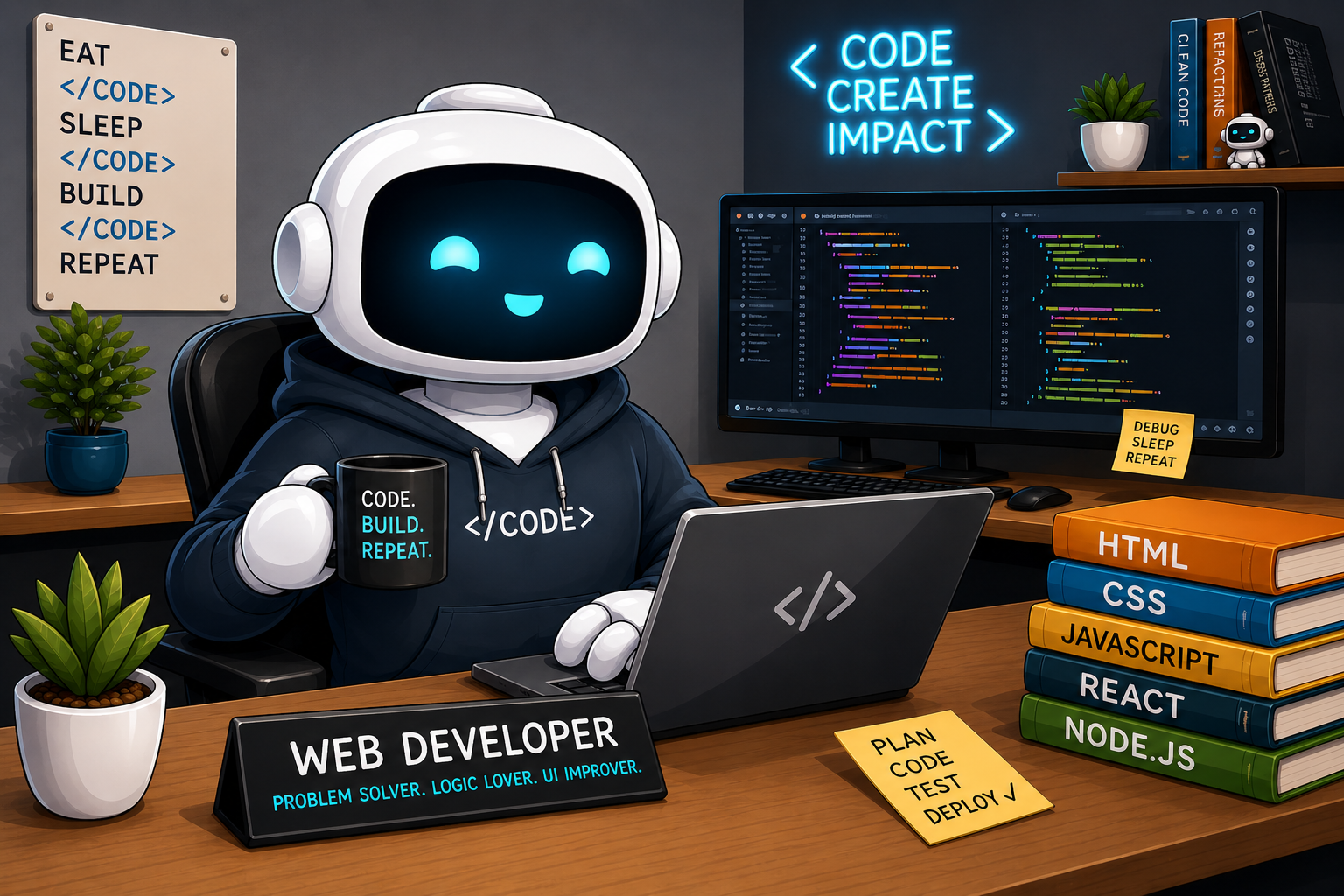
AI Can Build a Website. But It Can’t Build the Feeling That Makes It Work
The truth is: AI can build a website now.
It can generate layouts, structure pages, write copy, and assemble something that looks polished and complete in a fraction of the time it used to take.
And in certain cases, it works.
But here’s the part that matters: That’s not the hard part.
The Illusion of a “Finished” Website and Who It’s Built For
AI is incredibly good at building what we’ve all come to recognize as a proper website:
Clean navigation.
Logical structure.
Clear sections.
A predictable flow from top to bottom.
It pulls from millions of examples – ecommerce sites, blogs, SaaS platforms – and distills them into something that feels familiar and functional. Something that any user has probably used hundreds and thousands of times in their digital existence.
And that familiarity is intentional. Because most websites are designed to be:
- easy to use
- easy to understand
- easy to navigate
AI simply accelerates that.
It gives you the most optimized version of what already exists: A streamlined, tried-and-tested, common experience.
In many use cases, that can be exactly what your brand and company intends (or needs).
But in the role of branding and marketing for master-planned community developments – that’s the farthest thing from what your brand needs (and what users should want).
Where “Optimized” Starts to Fall Short
The more AI leans into what works universally, the more everything starts to feel the same.
Not worse. Just… interchangeable.
And that’s where the cracks start to show.
Because the websites that actually stick with people – the ones that create curiosity, give reason to pause, stir emotion and create brand connection – don’t always follow the expected path.
They bend it.
They stretch it.
Sometimes they slow it down.
Or speed it up to make you go back and experience it again.
They create moments where someone:
- lingers a little longer than they planned
- pauses to take something in
- re-reads a line
- explores instead of skimming
That’s not inefficiency.
That’s intention.
And ‘intention’ is a big thing in the new home marketplace right now, which we explore more in our blog post about 2026 housing market trends.
A Community Website Isn’t Built Like Everything Else
This is especially true in the world of master-planned communities.
You’re not selling a product that someone adds to a cart.
You’re introducing a place. A future version of someone’s life. A rhythm. A pace. A feeling.
And the website is often the first experience of that.
So the goal isn’t just clarity.
It’s immersion.
It’s about:
- building anticipation
- revealing information in a way that feels intentional
- guiding someone through a story, not just a sitemap
In that context, a “perfectly optimized” website can actually work against you.
Because if it feels like everything else…
it won’t be remembered.
The Role of the Unexpected
The best community websites don’t always behave the way you expect them to.
They might:
- introduce motion in subtle, deliberate ways
- layer content so it unfolds instead of dumps
- create navigation that invites exploration instead of rushing decisions
- use pacing, whitespace, and interaction to create mood
At times, they may even cause a moment of hesitation.
Wait… how does this work? But that moment isn’t friction. It’s engagement.
It’s the digital equivalent of slowing down when you enter a place that feels different. And that’s where connection starts.
Where AI Excels (And Where We Use It Because We Work Smarter AND Harder)
None of this is to say AI doesn’t belong in the process. It absolutely does.
We use it every day at A+B1.
To:
- accelerate early development and prototyping
- explore layout directions quickly
- assist with content structuring and refinement
- streamline updates and ongoing maintenance
- reduce time spent digging for answers or sifting through search results
AI has made a lot of the mechanics of web development faster and more efficient.
And that’s a good thing.
Because it gives us more space to focus on the parts that matter most: the experience and the emotive signals; the cues of delight.
Yet there are other facets of why an AI-built website has its pitfalls from the jump and after launch.
If You Don’t Understand What You’re Building…
There’s another layer to this that’s easy to overlook.
AI lowers the barrier to building a website.
But it also increases the likelihood of building something you don’t fully understand.
And when that happens, a new set of problems emerge:
When something breaks… how do you fix it?
When performance drops… what do you adjust?
When user behavior shifts… what do you change?
When the next phase of a community launches… how does the site evolve?
A website isn’t a one-time deliverable.
It’s a living ecosystem. Especially a website promoting a residential, mixed-use master-planned community. That puppy evolves multiple times before it lives on as a community connection point.
And without a clear understanding of how it’s structured – both technically and strategically – it becomes harder to maintain, adapt, and grow.
The Role We Play
Just like we began in our last blog post about how AI is transforming marketing, we at A+B1 see AI as a multiplier.
A way to move faster.
To test more.
To refine ideas more efficiently.
But never as a replacement for direction.
Because the real work isn’t in assembling pages.
It’s in shaping experiences, creating distinction, and translating a human vision into something people can actually feel – even when engaging through a screen.
In the end, AI can build a website – yes – but it can’t build anticipation.
It can’t create the curiosity that comes from knowing what the human conscience is pulled by.
It can’t engineer subtle moments that make someone pause, lean in, get a taste of nostalgia or aspiration.
Those things are still human-driven. They’re designed.
Intentionally.
And as websites become easier to create – the human direction will matter even more.
In our next blog post, we’re continuing the deep dive into how AI is changing the landscape for marketing by exploring the nature and evolution of design (and how AI is a catalyst for the next generation of what design really means).
For now, continue the conversation with us on LinkedIn, Facebook and Instagram. Find these posts about AI in marketing and give us your thoughts.